Nyhet
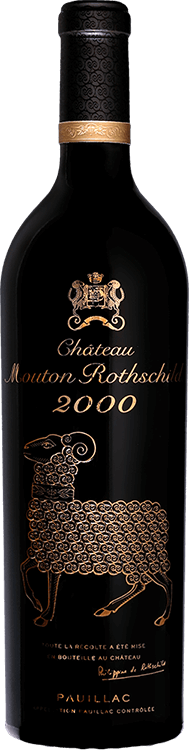
Château Mouton-Rothschild 2000
| Distrikt | Pauillac |
| Druvor | Cabernet Sauvignon, Merlot, Petit Verdot |
| Årgång | 2000 |
| Fyllighet | 9 |
| Fruktsyra | 9 |
| Strävhet | 9 |
| Procucenter | Château Mouton Rothschild |
| Artikelnr | MR 908 |
| Lagerstatus | |
| Förpackningsmaterial | Trälåda OWC |
| Fraktkostnad | 169:- |
| Avnjutes mellan | 2026 - 2055 |
Här redovisar och presenterar vi kända vinskribenters utlåtande om specifika viner. Utöver dessa lägger vi in en egen kommentar när vi har provat samma vin.
Druvor
86% Cabernet Sauvignon & 14% Merlot
Tasting note
Deep garnet colored with a touch of brick, the 2000 Mouton Rothschild (composed of 86% Cabernet Sauvignon and 14% Merlot) boldly bursts from the glass with tantalizing Black Forest cake, dried mulberries, kirsch and blackcurrant pastilles notes plus wafts of iodine, incense, potpourri and cinnamon stick with a hint of cigar boxes. Medium to full-bodied, the palate packs in the muscular fruit, framed by firm, ripe, grainy tannins and seamless freshness, finishing with phenomenal length. This is an incredibly complex and multifaceted wine, and it's drinking deliciously now. This said, I can’t help but feel that it is holding something back, that it still has another layer of opulence and seduction to reveal in its tight-knit fruit and solid structure. I personally can’t wait to see how this beauty will continue to unfold over the years to come.
-
At just over 80 hectares planted to vine, Mouton Rothschild, with its deep gravel soils, preponderance of old-vine Cabernet Sauvignon and distinctive style, is one of Bordeaux's most characterful wines. Today, under technical director Jean-Emmanuel Danjoy (who took the reins after stints at Opus One and Clerc Milon), the estate doesn't rest on its laurels: Mouton now hosts its very own research-and-development department, with its own experimental winery, and all sorts of projects are underway. In the vineyards, canopy management is being adapted on a site-by-site basis, with higher or lower hedging depending on the soils' hydrological profile; cover crops are increasingly part of the estate's strategy; drainage is being optimized in certain parcels; and a massal-selection program, housed in an in-house nursery, has been launched. In the winery, the parcel-by-parcel approach continues.
-
At just over 80 hectares planted to vine, Mouton Rothschild, with its deep gravel soils, preponderance of old-vine Cabernet Sauvignon and distinctive style, is one of Bordeaux's most characterful wines. Today, under technical director Jean-Emmanuel Danjoy (who took the reins after stints at Opus One and Clerc Milon), the estate doesn't rest on its laurels: Mouton now hosts its very own research-and-development department, with its own experimental winery, and all sorts of projects are underway. In the vineyards, canopy management is being adapted on a site-by-site basis, with higher or lower hedging depending on the soils' hydrological profile; cover crops are increasingly part of the estate's strategy; drainage is being optimized in certain parcels; and a massal-selection program, housed in an in-house nursery, has been launched. In the winery, the parcel-by-parcel approach continues.
-