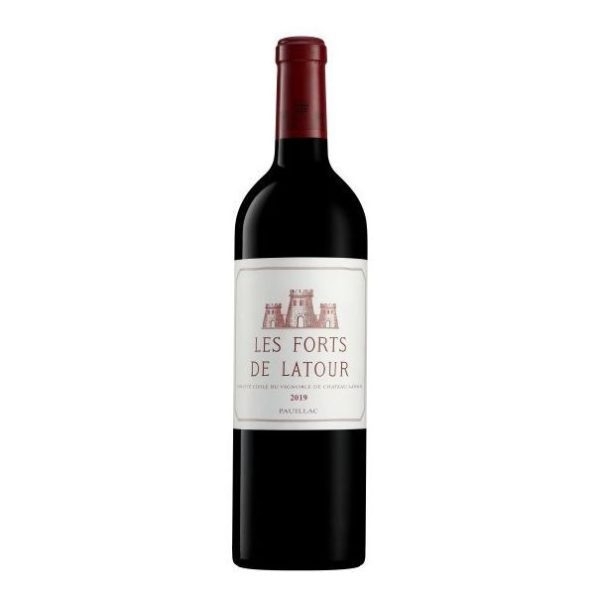
Les Forts de Latour 2020 [6-pac]
| Distrikt | Pauillac |
| Druvor | Cabernet Sauvignon, Cabernet Franc, Merlot, Petit Verdot |
| Årgång | 2019, 2020 |
| Fyllighet | 9 |
| Fruktsyra | 9 |
| Strävhet | 9 |
| Procucenter | Château Latour |
| Artikelnr | Latour 918 |
| Lagerstatus | |
| Förpackningsmaterial | Trälåda OWC |
| Fraktkostnad | 169:- |
Här redovisar och presenterar vi kända vinskribenters utlåtande om specifika viner. Utöver dessa lägger vi in en egen kommentar när vi har provat samma vin.
Druvor
70% Cabernet Sauvignon, 26.5% Merlot, resten Petit Verdot
Tasting note
The estate's second wine, produced from young vines, less optimally located parcels and any declassified lots, is the 2020 Le Pauillac de Château Latour, an attractive effort redolent of sweet berries, cassis, licorice and petals. Medium to full-bodied, with lively acids, sweet tannins and a penetrating finish, it combines immediate charm with aging potential.
Château Latour left the en primeur system in 2012, so the estate's latest releases are the 2020 Pauillac, 2019 Forts de Latour and 2016 Grand Vin de Latour, which I tasted at the estate with Technical Director Hélène Génin. Certified organic since 2018, most of Latour's historic "Enclos" is being farmed biodynamically these days, and its entirety is now cultivated by horse to minimize soil compaction and preserve intact as many old vines as possible. But the objective, above all, rather than subscribing to any particular theoretical approach, is to treat the vineyard holistically, as a system, within and with nature rather than against it. Winemaking is traditional, with macerations in stainless steel followed by maturation in barrel with rackings every three months and one fining with egg whites. Great attention is paid to the choice of barrels: each lot is tasted and its style defined before it's barreled down in cooperage adapted to that style. But if these methods realize the potential of this great site, what makes Latour's site so great? After all, this isn't the only vineyard to occupy the quaternary gravel terrace that makes its appearance along the banks of the Gironde. When I posed this question, Génin's response was to point to Latour's lenses of blue clay interfingered with and underlying those gravels. It's these pockets of clay in just the right places, Génin contends, that contain the secret to the wine's elegantly muscular power and immense longevity.
-
Robert Parker Wine Advocate

Château Latour left the en primeur system in 2012, so the estate's latest releases are the 2020 Pauillac, 2019 Forts de Latour and 2016 Grand Vin de Latour, which I tasted at the estate with Technical Director Hélène Génin. Certified organic since 2018, most of Latour's historic "Enclos" is being farmed biodynamically these days, and its entirety is now cultivated by horse to minimize soil compaction and preserve intact as many old vines as possible. But the objective, above all, rather than subscribing to any particular theoretical approach, is to treat the vineyard holistically, as a system, within and with nature rather than against it. Winemaking is traditional, with macerations in stainless steel followed by maturation in barrel with rackings every three months and one fining with egg whites. Great attention is paid to the choice of barrels: each lot is tasted and its style defined before it's barreled down in cooperage adapted to that style. But if these methods realize the potential of this great site, what makes Latour's site so great? After all, this isn't the only vineyard to occupy the quaternary gravel terrace that makes its appearance along the banks of the Gironde. When I posed this question, Génin's response was to point to Latour's lenses of blue clay interfingered with and underlying those gravels. It's these pockets of clay in just the right places, Génin contends, that contain the secret to the wine's elegantly muscular power and immense longevity.
-
Robert Parker Wine Advocate